Flash Updates
Largest Eye Care
22 Vision Centers
NABH Accredited
Since 2015

Shri Ganesh Vinayak Eye Hospital (SGVEH) Best Eye Care Network & Super Specialty Eye Hospital in Chhattisgarh & Central India Best Eye Hospital in Raipur Best Eye Hospital in Chhattisgarh Best Eye Hospital in Central India Best Eye Care Hospital in Chhattisgarh Best Eye Care Network in Central India Most Trusted Eye Hospital in Chhattisgarh Best Eye Specialist in Raipur Best Eye Doctor in Chhattisgarh Top Eye Specialists in Central India Advanced Eye Surgery & Treatments Cataract Surgeon in Raipur Best Cataract Surgery Hospital in Chhattisgarh Phaco Cataract Surgery Premium IOL Cataract Surgery ICL Surgery in Raipur IPCL Surgery in Chhattisgarh Advanced Vision Correction Surgery Squint Treatment in Raipur Squint Eye Surgery Hospital Pediatric Squint Specialist Retina & Vitreous Services (High SEO Value) Best Retina Surgeon in Raipur Best Retina Surgeon in Chhattisgarh Retina Specialist in Central India Retina Treatment Hospital Diabetic Retinopathy Treatment Retinal Detachment Surgery Macular Degeneration Treatment Vitrectomy Surgery Oculoplastic & Lacrimal Services Oculoplastic Surgeon in Raipur Oculoplastic Surgery Hospital in Chhattisgarh DCR Surgery in Raipur Endoscopic DCR Surgery PTR (Ptosis) Surgery Eyelid Surgery & Reconstruction Advanced Eye Diagnostics OCT Scan in Raipur OCT Angiography (OCTA) Fundus Photography Digital Fundus Imaging Advanced Retina Diagnostics Center Modern Eye Testing Facilities Complete Eye Care Network Comprehensive Eye Care Center Super Specialty Eye Hospital Eye Hospital in Raipur Eye Hospital in Jagdalpur Best Eye Hospital in Jagdalpur Eye Hospital in Champa Eye Hospital in Korba Eye Hospital in Ambikapur Eye Hospital in Dhamtari Eye Hospital in Kunkuri Eye Hospital in Chhattisgarh Eye Care Hospital in Central India Eye Hospital Network in Odisha & Chhattisgarh Brand Variations (SEO Safety) Shri Ganesh Vinayak Eye Hospital Shree Ganesh Vinayak Eye Hospital SGVEH – Best Eye Care & Retina Center

Effects of Anti-Tuberculosis (TB) Medications on the Eyes

Shri Ganesh Vinayak Eye Hospital (SGVEH)

Effects of Anti-Tuberculosis (TB) Medications on the Eyes

Certain anti-tuberculosis (TB) medicines, especially Ethambutol, can affect the optic nerve and cause vision problems such as blurred vision, color vision defects, or decreased visual acuity. Early detection and regular eye monitoring help prevent permanent vision loss.

Patients undergoing TB treatment should have a baseline and periodic eye examination to ensure safe continuation of therapy.
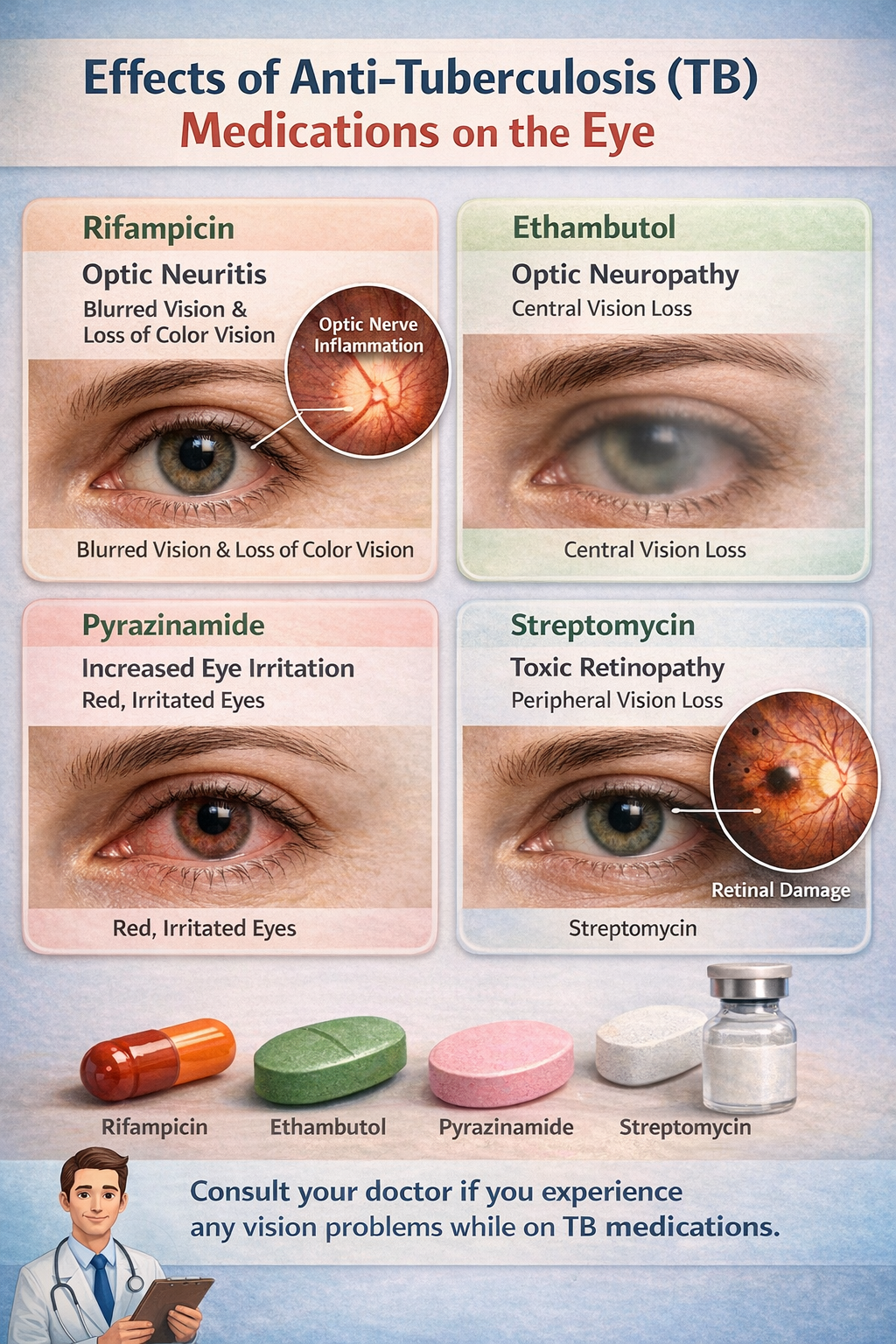
Effects of TB medications on eyes

How Do TB Medicines Affect the Eyes?

  • Optic Neuritis – Inflammation of the optic nerve
  • Reduced Visual Acuity – Blurred or dim vision
  • Color Vision Defect – Difficulty distinguishing red and green
  • Visual Field Changes – Patchy or peripheral vision loss
Important: Vision changes during TB treatment must be reported immediately to both your physician and eye specialist.

Who is at Higher Risk?

  • High doses of Ethambutol
  • Long duration of TB therapy
  • Kidney disease patients
  • Elderly patients

Prevention & Monitoring

Baseline Eye Exam

Before starting TB medication.

Monthly Vision Check

Especially during Ethambutol therapy.

Color Vision Testing

Detect early optic nerve toxicity.

Immediate Reporting

Stop medication only after consulting physician.

FAQs – TB Medicines & Eye Health

Which TB medicine commonly affects vision?

Ethambutol is most commonly associated with optic nerve toxicity.

Are vision changes reversible?

If detected early and medication is adjusted, vision may improve. Delay may cause permanent damage.

Should I stop TB medication if vision blurs?

No. Immediately consult your treating physician and eye specialist before stopping medication.

How often should eye exams be done during TB treatment?

At baseline and periodically during treatment, especially if taking Ethambutol.

Protect Your Vision During TB Treatment

Early screening prevents serious complications. Schedule an eye evaluation if you are on anti-TB therapy.

Effects of Arthritis (Autoimmune/Rheumatic Disease) on the Eyes

Shri Ganesh Vinayak Eye Hospital (SGVEH) • Comprehensive Eye Care

Effects of Arthritis (Autoimmune/Rheumatic Disease) on the Eyes

Arthritis and autoimmune rheumatic diseases can affect the eyes by causing dry eye, inflammation (uveitis), scleritis, and vision disturbances. These conditions occur because autoimmune diseases attack healthy tissues, including delicate eye structures. Early diagnosis and treatment are essential to prevent permanent vision damage.

Patients with rheumatoid arthritis, lupus, ankylosing spondylitis, or other autoimmune conditions should undergo regular eye examinations to detect silent inflammation early.
Effects of Arthritis on Eyes

How Can Arthritis Affect the Eyes?

  • Dry Eye Syndrome – Reduced tear production causing irritation and burning
  • Uveitis – Inflammation inside the eye leading to pain and light sensitivity
  • Scleritis – Deep eye inflammation causing severe pain
  • Retinal Vasculitis – Inflammation of retinal blood vessels
  • Medication Side Effects – Long-term steroid use may increase glaucoma or cataract risk
Important: Eye symptoms may appear before joint symptoms worsen. Immediate medical attention is required if vision changes occur.

Common Eye Symptoms in Autoimmune Arthritis

  • Redness and eye pain
  • Light sensitivity (photophobia)
  • Blurred or reduced vision
  • Excess tearing or dryness
  • Headache associated with eye pain

Diagnosis & Management

Comprehensive Eye Examination

Slit lamp evaluation and retinal assessment.

Inflammation Control

Anti-inflammatory drops or systemic treatment.

Lubrication Therapy

Artificial tears for chronic dry eye.

Regular Monitoring

To prevent complications such as glaucoma or cataract.

FAQs – Arthritis & Eye Health

Can rheumatoid arthritis affect the eyes?

Yes, it can cause dry eye, scleritis, and inflammation inside the eye.

Is uveitis serious?

Yes, untreated uveitis can lead to permanent vision loss.

Do arthritis medications affect vision?

Long-term steroid use may increase risk of glaucoma and cataract.

How often should arthritis patients get eye exams?

At least once a year, or more frequently if symptoms are present.

Protect Your Vision with Early Screening

If you have arthritis or any autoimmune condition, do not ignore eye symptoms. Early evaluation can prevent serious complications.

Cornea Specialist & Corneal Transplant in Raipur, Chhattisgarh — DSEK/DSAEK • DMEK • DALK • Keratoconus Care

Raipur • Chhattisgarh • Central India • Odisha • Korba • Champa • Jagdalpur • Dhamtari • Bilaspur

Cornea Specialist & Corneal Transplant in Raipur, Chhattisgarh — DSEK/DSAEK • DMEK • DALK • Keratoconus Care

Shri Ganesh Vinayak Eye Hospital (SGVEH) provides advanced cornea treatment and corneal transplant services in Raipur, including DSEK/DSAEK, DMEK, DALK and modern keratoconus management (C3R / corneal cross-linking). We support patients from across Chhattisgarh and Central India—including Korba, Champa, Jagdalpur, Dhamtari, Bilaspur—and nearby Odisha.

Cornea services and corneal transplant care in Raipur, Chhattisgarh, India
Cornea Care • Corneal Transplant • Keratoconus • Infection & Injury Treatment

Quick Overview

The cornea is the clear front layer of the eye. Cornea disease can cause blurred vision, pain, watering, redness, or whitening/scar. Many conditions are treatable—some need medicines, specialized lenses, or corneal transplant for vision restoration.

Corneal Transplant DSEK/DSAEK • DMEK DALK Keratoconus • C3R

Sudden pain, redness, white spot, injury, or rapid vision drop can be urgent—please seek cornea evaluation quickly.

Cornea Specialist

Cornea & Corneal Transplant Specialist in Raipur, Chhattisgarh

SGVEH cornea care focuses on accurate diagnosis, microscope-based evaluation, customized treatment plans and structured follow-up.

Dr Amrita Mukherjee cornea specialist and corneal transplant surgeon in Raipur Chhattisgarh India

Dr. Amrita Mukherjee

MBBS • DOMS • Cornea Consultant (LV Prasad Eye Institute)

Cornea • Corneal Transplant (DALK/DSAEK/DMEK) • Keratoconus (C3R)

Serving patients from Raipur across Chhattisgarh and Central India, including Korba, Champa, Jagdalpur, Dhamtari, Bilaspur and Odisha.
Cornea evaluation & imaging as needed
Keratoconus (C3R) counselling
Modern transplant options (DSEK/DMEK/DALK)
Infection/ulcer emergency care pathway

Cornea Conditions & Treatments at SGVEH

Corneal Transplant

Vision restoration for corneal scarring, opacity, and advanced corneal disease.

DSEK / DSAEK

Partial-thickness transplant for endothelial problems (cornea swelling).

DMEK

Advanced endothelial transplant technique for select candidates (high-quality vision recovery).

DALK

Lamellar transplant option for keratoconus/corneal scars where deeper layers are preserved.

Keratoconus (C3R)

Corneal cross-linking to strengthen cornea and slow progression in suitable cases.

Corneal Ulcer / Infection

Urgent diagnosis and treatment for microbial keratitis to prevent scarring and vision loss.

Dry Eye & Surface Disease

Chronic irritation, burning, watering—managed with step-wise therapy and follow-up.

Corneal Injury / Foreign Body

Emergency care for scratches, metal foreign body, chemical injury and trauma.

When to Consult a Cornea Specialist

Pain + Redness

Especially if there is light sensitivity, watering, or discharge.

White Spot on Cornea

May be corneal ulcer/infection—needs urgent evaluation.

Blurred Vision / Hazy Cornea

Corneal swelling or scar can reduce clarity and contrast.

Distortion in Vision

Can occur in keratoconus—early management protects vision.

Need cornea checkup or corneal transplant guidance?

Cornea Evaluation & Treatment at SGVEH (Step-by-Step)

1

History + Vision Testing

We assess symptoms, prior surgery/injury/contact lens use, and test vision and eye pressure.

2

Slit Lamp Cornea Examination

Detailed microscope exam checks corneal clarity, infection, scars and surface health.

3

Topography / Pachymetry (If Required)

For keratoconus and corneal shape evaluation, we may recommend corneal mapping and thickness tests.

4

Treatment Planning

Plan may include medicines, surface care, C3R, specialty lenses, or transplant depending on diagnosis.

5

Transplant & Follow-up (When Needed)

For eligible cases, we counsel on the right transplant type (DSEK/DMEK/DALK) and ensure structured follow-up for healing and vision recovery.

Frequently Asked Questions (FAQ)

What is a corneal transplant?

A corneal transplant replaces diseased or scarred corneal tissue with healthy donor tissue to restore clarity and vision.

Which transplant is better: DSEK, DMEK or DALK?

It depends on which cornea layer is affected. Endothelial problems may need DSEK/DMEK; keratoconus/scars may need DALK. A cornea specialist decides after examination.

Is keratoconus treatable without transplant?

Many keratoconus cases are managed with glasses, specialty lenses, and C3R (cross-linking) to slow progression. Some advanced cases may need transplant.

When is corneal ulcer an emergency?

If you have severe pain, redness, light sensitivity, discharge, or a white spot, it may be an ulcer and needs urgent evaluation to prevent scarring.

high BP: The “Silent Killer” of Your Vision

Alert Shri Ganesh Vinayak Eye Hospital • Raipur

High BP: The "Silent Killer" of Your Vision

Just like high water pressure can burst a pipe, High Blood Pressure (Hypertension) damages the tiny, delicate blood vessels inside your eyes. This condition is called Hypertensive Retinopathy.

👨‍⚕️ Dr. Charudutt Kalamkar
Retina Specialist
🎓 AIIMS New Delhi
Ex-Senior Resident
Best Retina Specialist in Raipur - Dr Charudutt

Save Your Sight

Early detection is the only cure.

How Does BP Damage the Eye?

Think of your eye's retina like a camera film. It needs a steady supply of blood.

When your Blood Pressure stays high (above 140/90) for a long time, the walls of the eye's blood vessels thicken to handle the pressure. Eventually, they become narrow or stiff.

The result? Blood cannot reach the retina properly, or the vessels burst (hemorrhage), causing vision loss.

4 Risks You Cannot Ignore

🩸

Retinal Bleeding

Small blood vessels burst inside the eye. You might see red patches or dark floating spots (floaters) in your vision.

🌑

Eye Stroke (Occlusion)

Just like a brain stroke, a clot can block an eye vein. This causes sudden, painless loss of vision in one eye. This is an emergency.

🔍

Macular Edema

Fluid leaks into the 'Macula' (the center of your vision). Things will look blurry, wavy, or distorted (straight lines look bent).

Optic Nerve Damage

High BP cuts off blood to the optic nerve (the cable connecting eye to brain). This can kill nerve cells and cause permanent blindness.

Warning Signs: When to see a Doctor?

Note: In early stages, there are NO symptoms. That is why routine checkups are vital.

  • Blurry Vision: Hard to focus while reading or watching TV.
  • Floaters: Seeing black spots or "mosquito-like" shapes flying in front of eyes.
  • Dim Vision: Feeling like lights are dimmer than usual.
  • Headaches: Specifically morning headaches with eye pain.
  • Sudden Vision Loss: Often happens upon waking up (Eye Stroke).

How We Treat It at SGVEH

Dr. Charudutt Kalamkar uses advanced AIIMS-standard protocols to save your vision.

01

Fundus Photography

We take a high-resolution photo of your retina to see leaking vessels.

02

OCT Scan

Like an MRI for the eye. It shows us swelling (fluid) inside the retinal layers.

03

Injections / Laser

If there is swelling or bleeding, we use Anti-VEGF injections or Green Laser to stop the leakage immediately.

Patient Questions (FAQs)

My vision is perfect. Do I still have damage?

Yes, possibly. BP damage starts at the outer edges of the retina where you don't notice it. By the time it affects your central vision (blurriness), the damage is already advanced. Diabetic and BP patients must get a checkup every 6 months.

Can glasses fix vision loss from High BP?

No. Glasses only fix focus issues. High BP damages the "film" (retina) inside. If the film is damaged, changing the lens (glasses) won't help. You need medical retinal treatment.

Is the vision loss permanent?

If caught early (swelling/bleeding), we can restore much of the vision using injections. However, if the Optic Nerve strokes out (dies due to lack of blood), that vision cannot be recovered. Time is critical.

What is an "Eye Stroke"?

It is a sudden blockage of the retinal vein or artery. It usually happens to people with uncontrolled BP. If you suddenly lose vision in one eye, come to the hospital immediately (within 4 hours) for the best chance of recovery.

Protect Your Eyes Today

Don't let High BP steal your sight. Book a comprehensive Retina Evaluation with Dr. Charudutt Kalamkar.

Call: 7880177784

Diabetic Retinopathy: Causes, Symptoms & Advanced Treatment

Shri Ganesh Vinayak Eye Hospital (SGVEH) • Raipur

Diabetic Retinopathy: Causes, Symptoms & Advanced Treatment

Diabetic Retinopathy is a diabetes-related complication that damages the retina. High blood sugar levels cause retinal blood vessels to leak, swell, or close, leading to vision loss if not treated by a specialist.

At SGVEH Raipur, Dr. Charudutt Kalamkar (MS AIIMS, New Delhi) uses gold-standard technology to detect and treat diabetic eye diseases before they become permanent.

✓ AIIMS Alumnus ✓ Advanced Laser Center
Dr. Charudutt Kalamkar - Diabetic Retinopathy Specialist Raipur
Dr. Charudutt Kalamkar
MS (AIIMS, New Delhi) • Vitreo-Retinal Specialist

What is Diabetic Retinopathy?

Diabetic retinopathy occurs when prolonged high blood sugar damages the microvasculature of the eye. It is the leading cause of vision loss in working-age adults. Initially, you may notice no changes, but as the condition progresses, it can cause bleeding inside the eye and retinal detachment.

Important: Diabetic retinopathy is often asymptomatic in its early stages. Annual screening is the only way to ensure your vision is safe.

Are You at Risk?

The risk of developing retinopathy increases the longer you live with diabetes. Key factors include:

Disease Duration

Risk increases significantly after 10–15 years of being diabetic.

📈

HbA1c Levels

Uncontrolled blood sugar (HbA1c > 7%) accelerates retinal damage.

🩸

Hypertension

High blood pressure adds strain to delicate retinal vessels.

Symptoms & Stages of Progression

Common Warning Signs

  • Floating dark spots or "cobwebs" (Floaters)
  • Blurred or fluctuating vision
  • Dark or empty areas in central vision
  • Difficulty perceiving colors accurately

The Clinical Stages

Non-Proliferative (NPDR): Early stage where vessels leak fluid or fats into the retina.

Proliferative (PDR): Advanced stage where fragile new vessels grow and bleed into the vitreous.

Advanced Treatment Modalities

Anti-VEGF Injections

Medicines like Lucentis or Avastin help reduce macular swelling and stop abnormal vessel growth.

Retinal Laser Therapy

Precision laser (Photocoagulation) seals leaking vessels and shrinks abnormal new growth.

Vitrectomy Surgery

A microsurgical procedure used for advanced cases involving vitreous hemorrhage or detachment.

The "ABC" of Vision Protection

A - A1c Control: Keep sugar levels stable.
B - Blood Pressure: Keep it below 130/80.
C - Cholesterol: Manage your lipid profile.

Regular annual dilated eye exams are the most effective way to prevent 95% of diabetes-related blindness.

Diabetic Retinopathy FAQs

Can diabetic retinopathy be reversed?

While advanced damage is permanent, early-stage NPDR can be managed and its progression halted through strict sugar control and specialist intervention.

Is the eye injection painful?

No. We use numbing drops and very fine needles. Most patients describe it as a slight pressure sensation rather than pain.

How often should I see a retina specialist?

Diabetic patients should have a comprehensive retinal exam at least once a year, or more frequently if any damage is detected.

Don't Wait for Vision Loss

Schedule your professional retina screening with Dr. Charudutt Kalamkar today at Shri Ganesh Vinayak Eye Hospital, Raipur.

Effects of Diabetes on the Eyes

Shri Ganesh Vinayak Eye Hospital

Effects of Diabetes on the Eyes:
Don't Ignore Blurry Vision

Dr. Charudutt Kalamkar MS (AIIMS, New Delhi) • Retina & Cataract Specialist
Dr. Charudutt Kalamkar inspecting a patient's eyes for diabetic retinopathy
AIIMS (New Delhi) Gold Medalist Care in Raipur

How Diabetes Attacks Vision

Diabetes causes excess sugar to accumulate in your bloodstream. This damages the microscopic blood vessels in the Retina (the camera film of your eye). These vessels may leak fluid, causing swelling (Edema), or close entirely, starving the eye of oxygen.

⚠️
Silent Threat: You can have Diabetic Retinopathy with 20/20 vision. Symptoms often only appear after irreversible damage has occurred.

4 Major Eye Risks for Diabetics

🩸

Diabetic Retinopathy

Weakened blood vessels bleed into the eye. Leading cause of blindness in adults.

💧

Macular Edema

Fluid leakage in the center of vision (Macula) causes waviness and blurring.

☁️

Early Cataract

High sugar levels cause the lens to cloud over faster than in non-diabetics.

👁️

Glaucoma

Double the risk of high eye pressure, damaging the optic nerve silently.

⚠️ Watch For Symptoms

  • Floating dark spots or "spider webs"
  • Fluctuating vision (clear one day, blurry next)
  • Dark or empty areas in vision
  • Difficulty perceiving colors

🛡️ Prevention Strategy

  • Strict HbA1c (Sugar) control
  • Keep blood pressure below 130/80
  • Annual Retina Scan (Dilated Exam)
  • Quit smoking immediately

Frequently Asked Questions

Can I go blind from diabetes?
Yes. Diabetic retinopathy is a leading cause of preventable blindness. However, 90% of this blindness can be prevented with early detection and treatment at SGVEH.
How often do I need an eye exam?
Every diabetic patient needs a dilated fundus examination at least once a year, starting from the time of diagnosis for Type 2 diabetes.
Is the eye damage reversible?
Early swelling (edema) can often be treated with injections or laser. However, scar tissue and dead retinal cells cannot be regenerated. Prevention is better than cure.
📞 Call

Glaucoma Treatment in Raipur: Symptoms You Should Not Ignore

Glaucoma Treatment in Raipur | Dr. Charudutt Kalamkar
Expert Glaucoma Care in Raipur

Glaucoma Treatment in Raipur: Symptoms You Should Not Ignore

What is Glaucoma?

Glaucoma (Kala Motia) is a progressive eye condition that damages the optic nerve, often due to high eye pressure. It is known as the "silent thief of sight" because it causes permanent vision loss without early symptoms.

Consult Dr. Charudutt Kalamkar (MS AIIMS, New Delhi)
Specialist in Glaucoma, Cataract & Neuro-Ophthalmology

Dr. Charudutt Kalamkar Glaucoma Specialist
15+ Years of Excellence

Understanding the Symptoms

In the early stages, Open-Angle Glaucoma has no warning signs. As the disease progresses, blind spots develop in your side (peripheral) vision. Regular checkups are the only way to catch it early.

Tunnel Vision

Gradual loss of peripheral vision, leaving only central sight.

Halos & Glare

Seeing rainbow-colored circles around bright lights.

Eye Pain

Sudden, severe eye pain accompanied by redness (Acute cases).

Nausea

Upset stomach or vomiting linked to eye pressure spikes.

Advanced Treatment Options at SGVEH

While vision loss cannot be recovered, we can prevent further damage using world-class technology.

💧

Medical Therapy

Prescription eye drops to decrease eye fluid production or increase outflow.

Laser Treatment

Painless laser procedures (SLT/LPI) to open drainage angles and lower pressure.

🔬

Micro-Surgery

Advanced surgical interventions like Trabeculectomy for complex cases.

Frequently Asked Questions

Can Glaucoma be cured permanently?

No, glaucoma cannot be cured, and lost vision cannot be restored. However, it can be managed effectively to prevent blindness through early diagnosis and consistent treatment.

Is the treatment painful?

Most treatments, including lasers, are painless and performed in the OPD. Surgery is done under local anesthesia with minimal discomfort.

How often do I need to visit the doctor?

Glaucoma patients typically need checkups every 3 to 6 months to monitor eye pressure (IOP) and optic nerve health.

Don't Let Glaucoma Steal Your Sight

Book a comprehensive eye evaluation with Dr. Charudutt Kalamkar today.

Eyelid Infections: Causes, Symptoms & Care

Advanced Eye Care Raipur

Eyelid Infections:
Causes, Symptoms & Care

Painful swelling, redness, or lumps on your eyelid? Get expert diagnosis and relief. Trusted by patients across Raipur, Chhattisgarh & Odisha.

Direct WhatsApp: 7880177784

What Are Eyelid Infections?

Eyelid infections occur when bacteria or blocked oil glands cause inflammation of the eyelid margin. In urban hubs like Raipur, Bilaspur, Durg, and Bhilai, factors like pollution and dust significantly increase cases of styes and chalazions.

Fig 1: Difference between a Stye (infection) and Chalazion (blockage).

🔴 Stye (Hordeolum)

Painful red bump caused by bacterial infection at the eyelash base.

⚪ Chalazion

Painless, firm lump due to a blocked oil gland further back on the lid.

🔥 Blepharitis

Chronic inflammation causing crusty dandruff-like flakes on eyelashes.

⚠️ Preseptal Cellulitis

Spreading infection causing entire eyelid swelling. Needs urgent care.

Symptoms to Watch For

  • Redness and localized swelling
  • Pain or tenderness when blinking
  • A palpable lump or bump
  • Sticky discharge or crusting
  • Excessive tearing
  • Sensitivity to light

Why do they happen?

Common causes include:

  • Bacterial Contamination: Staphylococcus bacteria is a common culprit.
  • Blocked Glands: Oil glands (Meibomian glands) get clogged.
  • Hygiene: Touching eyes with unwashed hands or old makeup.
  • Skin Conditions: Rosacea or seborrheic dermatitis.

*Warm compresses are the first line of defense.

Dr Charudutt Kalamkar - Eye Specialist Raipur
Leading Eye Specialist in Raipur

Dr. Charudutt Kalamkar (MBBS • MS AIIMS)

Dr. Charudutt Kalamkar is a distinguished ophthalmologist trained at the prestigious AIIMS, New Delhi. With over two decades of experience, he leads the advanced eye care team at SGVEH.

✔️ Cataract Surgery ✔️ Glaucoma ✔️ Neuro Ophthalmology ✔️ Complex Infections

Why Patients Trust Him: Known for his precise diagnosis and evidence-based approach to treating inflammatory eye conditions and infections.

Frequently Asked Questions

Some bacterial infections causing styes can spread through direct contact or sharing towels/makeup. However, chalazions (blocked glands) are generally not contagious. Good hygiene is key.
Most styes resolve within 7–10 days with home treatment like warm compresses. If it persists or affects vision, medical intervention may be needed.
See a specialist immediately if the swelling spreads to the rest of the face, your vision changes, the pain becomes severe, or the stye bleeds/doesn't heal after a week.
You can book an appointment at SGVEH Raipur by clicking the "Consult Eye Specialist" button above or messaging us on WhatsApp at 7880177784.

Best Pediatric Eye Specialist in Raipur for Kids Eye Care

Pediatric Eye Care Raipur

Best Pediatric Eye Specialist in Raipur for Kids Eye Care

Redness, discharge, or swelling in your child's eyes? Early diagnosis prevents long-term vision issues. Trusted by parents across Raipur, Chhattisgarh & Odisha.

Direct WhatsApp: 7880177784

Child suffering from eye infection illustration

What Are Pediatric Eye Infections?

Children are more vulnerable to eye infections because they frequently touch their eyes and play in close contact with others. In urban hubs like Raipur, Bilaspur, Durg, and Bhilai, factors like pollution, school outbreaks, and seasonal changes significantly increase cases of conjunctivitis and bacterial infections.

🦠 Conjunctivitis

"Pink Eye" causing redness and sticky discharge.

👁️ Stye

Painful red bump on the eyelid due to blocked glands.

🌾 Allergic Reaction

Itching and watering caused by dust or pollen.

⚠️ Corneal Infection

Serious condition requiring immediate specialist care.

Symptoms to Watch For

  • Redness in one or both eyes
  • Yellow or sticky discharge (crusting)
  • Swollen eyelids or under-eye bags
  • Excessive watering or tearing
  • Sensitivity to light (Photophobia)
  • Complaints of blurred vision

Why do they happen?

Most infections stem from:

  • Viruses & Bacteria: Spread easily in schools/daycares.
  • Hygiene: Touching eyes with unwashed hands.
  • Allergens: Seasonal pollen or dust in industrial areas.

*Prevention starts with hand washing.

Dr Patel Bhavin - Pediatric Eye Specialist Raipur
Leading Child Eye Specialist

Dr. Patel Bhavin (MBBS • DNB)

Dr. Patel Bhavin is a renowned name in pediatric ophthalmology in Chhattisgarh. He specializes in treating delicate vision issues in infants and children with a gentle, child-friendly approach.

✔️ Squint Management ✔️ Congenital Cataract ✔️ Eye Infections ✔️ Pediatric Oculoplasty

Why Parents Trust Him: He ensures accurate diagnosis avoiding unnecessary medication, focusing on the long-term visual development of your child.

Frequently Asked Questions

Yes, conditions like Viral Conjunctivitis (Pink Eye) are highly contagious. They spread through direct contact or shared towels. It is best to keep your child home from school until the discharge stops.
Apply a warm compress (clean cloth soaked in warm water) to the eye for 10 minutes, 3-4 times a day. Do not pop or squeeze the stye. If it persists beyond 3 days, visit a specialist.
Avoid using steroid eye drops without a prescription. Using the wrong drops can worsen viral or fungal infections and may damage vision. Always consult a pediatric ophthalmologist first.
You can book an appointment at SGVEH Raipur by clicking the "Book Consultation" button above or messaging us on WhatsApp at 7880177784.

Spectacle Number in Children: Causes, Treatment & Preventio

Pediatric Care Shri Ganesh Vinayak Eye Hospital • Raipur

Does Your Child Need Glasses? Early Detection is Key

Spectacle Number (Refractive Error) in children happens when the eye cannot properly focus light on the retina. If left untreated, it can lead to lazy eye (Amblyopia), poor academic performance, and permanent vision issues.

👶 Child-Friendly Care
🏥 AIIMS Standard Treatment
Child wearing glasses - Pediatric Eye Care

Protect Their Future

80% of a child's learning is visual.

Why Does a Child Get a "Number"?

Think of the eye like a camera. The front of the eye (cornea and lens) focuses light onto the back of the eye (retina), which acts like the camera's film.

If the eyeball is slightly too long, too short, or the cornea is uneven, the light doesn't focus exactly on the "film." This makes the picture blurry. A spectacle lens simply bends the light before it enters the eye, fixing the focus.

Types of Refractive Errors in Children

📱

Myopia (Minus Number)

Near-Sightedness: The child can see phones and books perfectly, but the blackboard or TV looks blurry. This is rapidly increasing due to screen time.

📖

Hyperopia (Plus Number)

Far-Sightedness: The child struggles to focus on nearby objects like books or toys, often causing headaches or eye-crossing (squint).

🏈

Astigmatism (Cylindrical)

Distorted Vision: The eye is shaped like a rugby ball instead of a football. It makes vision blurry or stretched at all distances.

Hidden Signs: Is Your Child Struggling?

Children rarely complain about bad vision because they think everyone sees the world exactly as they do. Watch for these clues:

  • The "Squeeze": Squinting or half-closing eyes to see the TV or whiteboard.
  • Getting Too Close: Holding books right up to their nose or sitting very close to the TV.
  • Constant Rubbing: Frequent eye rubbing, especially while trying to concentrate.
  • School Struggles: Sudden drop in grades, or losing place while reading.
  • Physical Pain: Complaining of headaches or tired eyes after school.
Dr. Charudutt Kalamkar - Best Pediatric Eye Specialist Raipur

Meet Our Pediatric Expert

Dr. Charudutt Kalamkar

🎓 MBBS, MS (AIIMS, New Delhi) 🏥 Ex-Senior Resident, AIIMS

When it comes to your child's vision, experience matters. Dr. Kalamkar specializes in diagnosing complex refractive errors and amblyopia (lazy eye) in children, ensuring they get the best start in life with clear vision right here in Raipur.

Causes & Our "Myopia Control" Approach

01

Screen Time Management

Staring at screens triggers the eyeball to grow longer (Myopia). We advise the 20-20-20 rule to reduce strain.

02

Natural Sunlight

Outdoor play in natural sunlight releases dopamine, which stops the eye from growing too long. 1-2 hours daily is essential.

03

Advanced Treatment

For rapidly increasing numbers, SGVEH offers Myopia Control Drops (Atropine) and special lenses to slow down progression.

Parents' Frequently Asked Questions

Will eating carrots remove the spectacle number?

No. While a healthy diet with Vitamin A is great for eye health, it cannot change the physical shape of the eyeball. Glasses are necessary to focus light correctly.

Will wearing glasses make my child's eyes weaker?

This is a myth. Glasses do not weaken the eyes; they help the brain see clearly. NOT wearing glasses can lead to "Lazy Eye" (Amblyopia).

At what age should a child have their first eye test?

By age 3 or 4, and definitely before starting school. We use special pediatric charts with shapes, so they don't need to know how to read.

Don't Let Poor Vision Hold Them Back

A simple eye test can change your child's confidence and performance in school.