
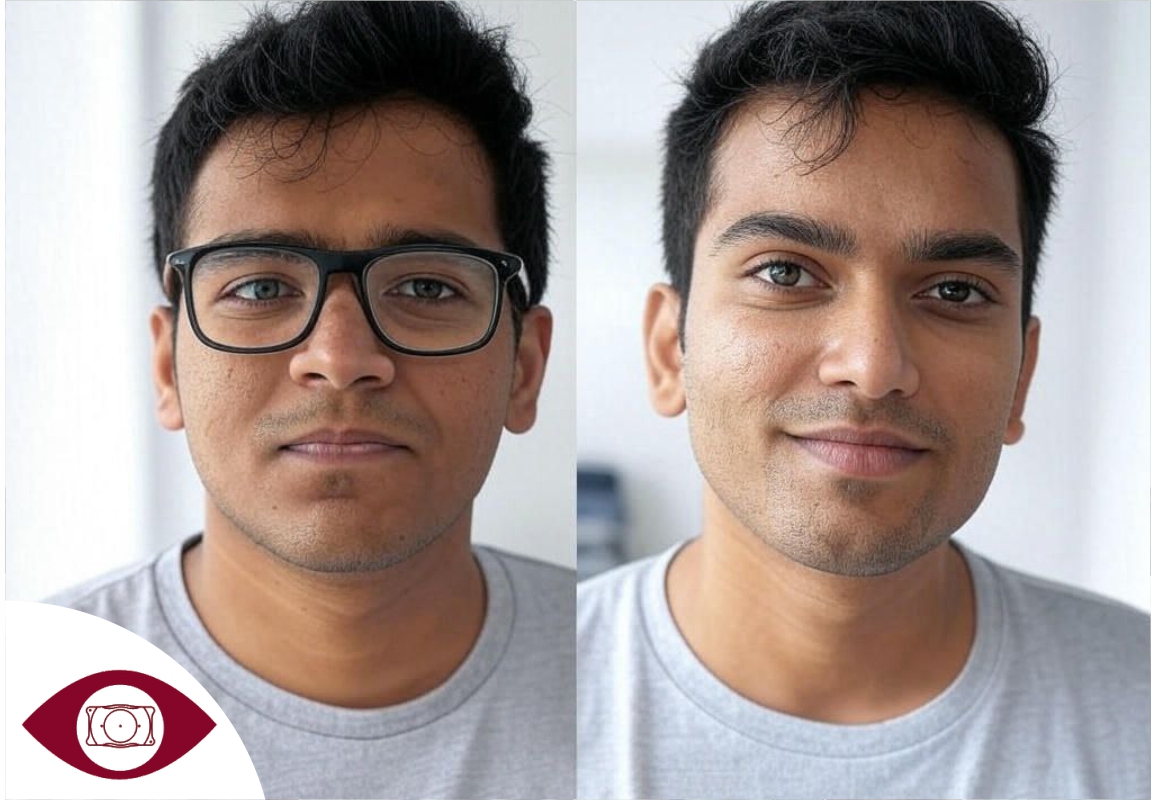
Glasses can be a daily hassle — for sports, uniformed-service jobs, weddings or simply comfort. Many young adults in Raipur and across Chhattisgarh ask how to get rid of them. Modern refractive procedures are safe and effective when the right procedure is chosen for the right eye.
Who can consider spectacle removal?
- Generally adults aged 18 or above (ICL is usually planned a little later, once power is stable).
- Spectacle power stable for about a year.
- Healthy cornea and retina with no active eye disease.
- Realistic expectations — reading glasses may still be needed after about 40.
Pregnancy, uncontrolled diabetes, very dry eyes, keratoconus or other corneal problems may make a procedure unsuitable or need special planning.
PRK — surface laser
In PRK (photorefractive keratectomy) the thin surface layer of the cornea is removed and a laser reshapes the cornea to correct the power. The surface heals over a few days, during which a bandage contact lens is used and the eye may feel watery and sensitive. Vision improves gradually over the following weeks. PRK suits many patients with mild to moderate power and adequate corneal thickness.
ICL and IPCL — a lens inside the eye
An implantable collamer lens (ICL) or implantable phakic contact lens (IPCL) is a very thin lens placed inside the eye, in front of your natural lens, through a tiny opening. Nothing is removed from the cornea. It is often chosen for high power, thin corneas or when laser is not suitable. Vision recovery is usually quick, and the lens can be removed if ever needed.
Tests before surgery
- Accurate refraction (with and without dilating drops).
- Corneal topography/tomography and pachymetry (thickness).
- For ICL/IPCL: anterior chamber depth and white-to-white measurements, endothelial cell count.
- Dry-eye assessment and a dilated retina check.
Stop soft contact lenses for some days before the tests, as advised, because lenses change the corneal shape.
After the procedure
- Use drops exactly as prescribed and avoid rubbing the eyes.
- Avoid swimming, dust and eye make-up for the period your doctor advises.
- Attend all follow-ups — they are short but important.
Learn more on the Refractive Care: PRK, ICL & IPCL page, or call/WhatsApp +91 9644902896 to book a suitability check.
Frequently asked questions
Which is better, PRK or ICL?
Neither is better for everyone. PRK suits many people with moderate power and adequate corneal thickness; ICL/IPCL suits higher power or thinner corneas. Tests decide the safe option.
Will I never need glasses again?
Most patients become largely independent of distance glasses, but reading glasses are usually needed after about 40, and a small residual power is possible.
How long should my power be stable?
Usually at least about one year. Your doctor will compare old and new prescriptions.
Where can I get a specs-removal check-up in Raipur?
At SGVEH, opposite Colors Mall, Pachpedi Naka, Raipur. Call or WhatsApp +91 9644902896.
Related reading
This article is for general education and does not replace a personal eye examination. Diagnosis and treatment vary from patient to patient.


 Team · Trust · Technology